Published June 2026
This guide outlines the new requirement for gender equality reporting in departmental annual reports.
Back to topPurpose of the reporting
The Australian Government is committed to creating a better, gender equal Australia for everyone. Key to delivering on this commitment is Working for Women: A Strategy for Gender Equality (Working for Women), which sets out priority areas for action over 10 years.
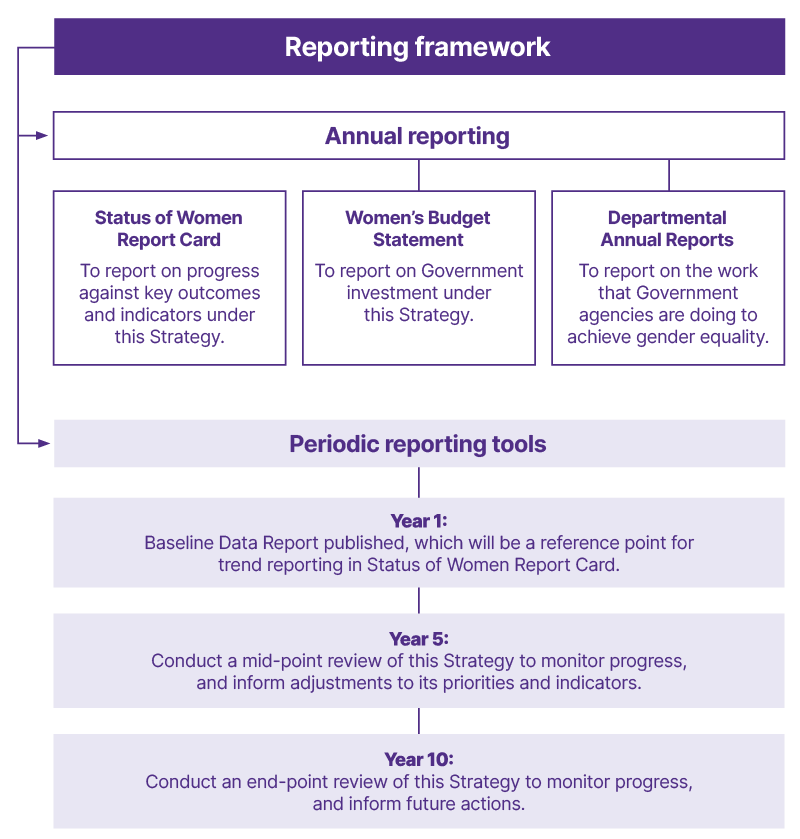
To support implementation, Working for Women includes a reporting framework (outlined in Figure 1) that requires Departments of State1 (departments) to report annually on how their work contributes to gender equality. Incorporating this information into APS annual reports aligns with the existing purpose of annual reporting, to provide parliament and the public with a clear, transparent account of performance and use of public resources. By including gender equality reporting, agencies demonstrate how their activities advance whole‑of‑government commitments.
Figure 1: Working for Women reporting framework (page 88 of Working for Women)
Reporting framework text description
Annual reporting:
- Status of Women Report Card: To report on progress against key outcomes and indicators under this Strategy
- Women's Budget Statement: To report on Government investment under this Strategy.
- Departmental Annual Reports: To report on the work that Government agencies are doing to achieve gender equality.
Periodic reporting tools:
- Year 1: Baseline Data Report published, which will be a reference point for trend reporting in Status of Women Report Card.
- Year 5: Conduct a mid-point review of this Strategy to monitor progress, and inform adjustments to its priorities and indicators.
- Year 10: Conduct an end-point review of this Strategy to monitor progress, and inform future actions.
This annual gender equality report will form a key pillar of Working for Women’s monitoring and accountability framework by:
- demonstrating progress towards gender equality outcomes
- increasing transparency across government
- strengthening gender analysis capability within the APS
- informing monitoring and reporting of actions and outcomes achieved under Working for Women (including it’s 5-year and 10-year review).
Governance and authority of reporting requirement
As part of the policy authority to implement Working for Women, all departments are required to fulfil the reporting requirement. Other agencies are also encouraged to adopt gender equality reports in their annual reporting.
The reporting requirement is to be completed in accordance with Section 46 of the Public Governance, Performance and Accountability Act 2013 (PGPA Act) and RMG 135: Annual Report Content Requirements (as outlined within the ‘Management and accountability’ section).
This reporting focuses on policy and program impacts and capability‑building for gender equality, rather than corporate HR or diversity initiatives. This reporting does not include workforce composition, employment conditions, workplace gender equality metrics, HR programs, or staff networks, which are reported separately under the PGPA Act, Workplace Gender Equality Act 2012 and other regulatory frameworks.
Back to topReporting requirements
From 2025–26, all departments are required to include gender equality reports in their annual reports. Departments are required to report on key initiatives, policies, programs or activities within their portfolio responsibilities that have a stated intent, or contribute to advancing gender equality outcomes, aligned to one or more of the Working for Women Strategy priority areas.
In addition to this core requirement, reporting may also include examples of:
- internal departmental activities that strengthen gender analysis capability or embed gender equality principles in policy development
- outcomes of policies or programs informed by gender analysis or gender impact assessments (GIA).
Required elements
Gender equality reports must:
- be clearly identifiable within the departmental annual report, under the heading ‘Gender Equality Reporting’ or a clearly equivalent title
- provide a high‑level overview of portfolio responsibilities and how they present opportunities to advance gender equality, for example:
- the Department of Education’s portfolio responsibility for supporting the Child Care System (under the portfolio’s Outcome 1) provides an opportunity to improve working conditions for early childhood and education care (ECEC) workers – a highly gender-segregated workforce
- identify key initiatives (policies, programs, activities) that contribute to advancing gender equality, aligned to one or more of Working for Women’s priority areas2:
- gender-based violence
- unpaid and paid care
- economic equality and security
- health
- leadership, representation and decision-making.
Note: Departments are not required to report against all 5 priority areas.
- focus on activities that materially contribute to gender equality outcomes, supported by appropriate evidence where available, including qualitative and quantitative data, such as performance indicators3 , stakeholder insights, and evaluation findings that demonstrate meaningful impacts on the lives of Australians
- demonstrate consideration of gender equality and gender mainstreaming4 in initiatives from across the portfolio, including engaging non‑traditional policy areas5 , not limiting reporting to initiatives or programs that are explicitly or traditionally gender‑focused
- be concise (1–3 pages).
Optional inclusions
Depending on available and publishable information, reporting may also include:
- internal agency initiatives that strengthen gender analysis capability (such as internal staff training) or embed gender equality considerations in policy development and implementation
outcomes of policies or programs informed by gender analysis or gender impact assessments (GIAs), including through gender responsive budgeting (GRB) processes, including highlighting the policy outcomes or progress the policy or program is making toward advancing gender equality
- GRB has been applied to Budget processes since the 2023–24 MYEFO and remains a shared responsibility across government to inform policy development and implementation.
Note: Avoid repeating the original GIA content and instead focus on what has been achieved because of the gender analysis
- outcomes of measures included in previous Women’s Budget Statements, including outlining how these measures have contributed to gender equality outcomes during the reporting period
- acknowledgement of areas where gender mainstreaming is at an early stage, and planned actions to strengthen capability over time.
Departments are encouraged to use the following standard opening text at the commencement of the section:
In line with commitments made under Working for Women: A Strategy for Gender Equality, Australian Government departments have committed to report on their efforts to achieve gender equality and build gender analysis capability in their annual reports. As part of this initiative, this annual report includes case studies to demonstrate how the department is working towards the ambition of a better, gender equal Australia for everyone.
A simple reporting checklist is available at Appendix A.
Examples of the 2024–25 Gender Equality Reporting pilot are available in the following annual reports:
- Department of Climate Change, Energy, the Environment and Water Annual Report 2024-25
- Department of Industry, Science and Resources Annual Report 2024–25
- Department of Education Annual Report 2024–25
- Department of the Prime Minister and Cabinet Annual Report 2024–25
Roles and responsibilities
The gender equality reporting requirement will rely on diverse contributions from different teams across each department.
The Office for Women (OFW), in the Department of the Prime Minister and Cabinet (PM&C), is stewarding the implementation of gender equality annual reporting. OFW will engage with departments throughout the reporting process to assist with consistent and accurate application of the requirements.
Departments are responsible for meeting the reporting requirements. In most cases, several internal teams will contribute to developing gender equality reporting, as outlined in the table below. These roles may vary depending on each department’s structure and approach to corporate annual reporting.
| Team | Responsibility |
|---|---|
| Corporate / Reporting | Provide guidance on content placement, advise on internal drafting and clearance timelines, and facilitate clearance and publication in the annual report. |
| Strategic policy | Lead coordination for gender equality reporting, including drafting content and liaising with policy teams for input. |
| Policy and program | Provide input on initiatives that impact or advance gender equality. |
| SES | Ensure departmental engagement, reinforce purpose of reporting, support relevant teams to fulfil reporting requirements, and ensure accuracy of information. |
Detailed team personas are available at Appendix B.
Back to topGender equality report placement in annual reports
Annual reports are deliberately standardised to meet the mandatory requirements set out in the Public Governance, Performance and Accountability Rule 2014, with minor tailoring for portfolio‑specific material.
Departmental reporting teams are to advise on the appropriate placement of the gender equality reports. In line with RMG 135, it is suggested the report is placed in the ‘management and accountability’ section of the annual report, however the ‘appendices’ or other appropriate sections are acceptable if required.
Back to topTimeframes
Timeframes for drafting gender equality reports should align with departmental annual report timeframes, which are set by corporate reporting teams.
Key statutory milestones
- General reporting period: 1 July to 30 June
- Annual report provided to responsible Minister: by 15 October
- Annual report tabled in Parliament: ordinarily on or before 31 October, and generally ahead of October Estimates hearings
Typical drafting timeline
- April – June: corporate reporting teams typically commence drafting annual report content. Early engagement between corporate reporting teams and policy and program areas is critical during this period.
- June – August: annual report content, including gender equality reporting, is drafted and refined. Input from policy and program areas is consolidated, and evidence and case studies are finalised.
- September: finalisation, internal clearance and SES approval of content.
- By 15 October: annual report, including gender equality reporting, provided to the responsible Minister.
- By 31 October: annual report tabled in Parliament.
Given the tight clearance and publication timeframes later in the process, departments are encouraged to begin coordinating gender equality reporting early, particularly with:
- corporate reporting teams on placement and formatting
- policy and program areas on identifying initiatives, evidence and case studies.
Appendix A: Reporting checklist
Departmental teams coordinating gender equality reports may use the checklist below to support drafting and internal clearance processes.
Required elements
- Section titled ‘Gender Equality Reporting’
- Overview of portfolio responsibilities and gender equality intersections
- Initiatives with gender impacts identified, including outcomes of policies or programs informed by gender analysis or gender impact assessment
- Mainstream and non‑traditional initiatives included
- Report limited to 1–3 pages
Optional elements
- Standard opening text
- Internal initiatives to strengthen gender analysis capability or embed gender equality in policy development and implementation
- Outcomes of policies or programs informed by gender analysis or GIAs
- Outcomes of measures from previous Women’s Budget Statements
- Identified opportunities for maturity
For advice or support, contact OFWImplementation@pmc.gov.au.
Back to topAppendix B: Team personas

Sophie – Corporate Reporting Manager
Sophie is responsible for coordinating the department’s annual report.
To play my part in delivering the new reporting requirement, I need to:
- advise on placement of the gender equality reporting section in the annual report and ensure it is appropriately positioned
- confirm my SES understand and approve inclusion of the new section and approach for reporting
- advise the central coordinating team on internal times for drafting the reporting content
- ensure the report meets the gender equality annual reporting guidelines and requirements of the PGPA Rule.
- coordinate clearance and publication processes through the standard corporate processes.

Ethan – Strategic Policy Team / Central Coordination Team
Ethan is responsible for setting the direction and coordinating across policy areas to support whole‑of‑department objectives. He also supports teams to apply a gender lens to policies, programs and services.
To play my part in delivering the new reporting requirement, I need to:
- receive adequate support from SES, COO and departmental staff to contribute to reporting
- familiarise myself with guidance on how to implement the gender equality reporting requirement so I support corporate and policy teams
- act as the central point for coordinating the gender equality report
- draft the overarching narrative and portfolio‑level overview
- liaise with policy and program teams (as early as possible in the reporting year) to identify relevant initiatives for inclusion in the reporting
- ensure reporting aligns with the Working for Women priority areas
- engage with the Office for Women as needed.

Maya - Program Director
Maya is the lead for the Building Better Roads infrastructure program. She is responsible for the operational delivery of multiple programs and is not typically involved in gender equality strategy.
To play my part in delivering the new reporting requirement, I need to:
- understand that the policy or program doesn’t have to be focused on women to contribute to the reporting
- identify initiatives within my area that could have gendered impacts and share them with Ethan (Strategic Policy Team)
- if asked to contribute to the reporting, clearly articulate how the program is contributing to advancing gender equality including by providing the relevant evidence.

Alex – Office for Women
Alex is an Advisor in the Office for Women. They are responsible for assisting policy and program teams across government to complete gender equality reporting.
To play my part in delivering the new reporting requirement, I need to:
- confirm support from COOs and SES across government by communicating the gender equality reporting requirements
- provide clear guidance materials to teams in other government departments
- be the contact point, and provide advice to corporate and strategic policy teams completing the reporting.
Endnotes
- Department of State means a Department of the Commonwealth established under section 64 of the Australian Constitution and recognised as a non‑corporate Commonwealth entity under the Public Governance, Performance and Accountability Act 2013. More information is available at finance.gov.au/government/managing-commonwealth-resources/structure-australian-government-public-sector/types-australian-government-bodies.Return to endnote 1 ↩
- Each of the 5 priority areas are detailed from page 33 onwards in Working for Women: A Strategy for Gender Equality.Return to endnote 2 ↩
- Performance indicators relating to the measure being reported on. This is separate to PGPA performance measures.Return to endnote 3 ↩
- As defined by the OECD, gender mainstreaming is ‘the systematic integration of a gender perspective into the design, implementation, monitoring, and evaluation of all policies and programmes’. Find more information at: oecd.org/en/topics/gender-mainstreaming-in-policy-making.Return to endnote 4 ↩
- Non‑traditional policy areas are those that are not explicitly, primarily or historically framed as addressing gender equality, women, care, or family outcomes, but which may have direct or indirect gendered impacts. This includes, but is not limited to, areas such as economic, fiscal, infrastructure, industrial, environmental, security, regulatory, digital, science, energy, transport, and procurement policy.Return to endnote 5 ↩